
Roofing Terminology Without Guesswork
Roofing terminology is the language used to measure a roof, define the scope of work, specify materials, explain warranties, and document project risk. This guide defines the roofing terms homeowners are most likely to see in estimates, measurement reports, insurance scopes, warranties, and installation conversations.
Written by: Idan B.
The purpose is simple: to make the language clear before decisions are made.
This is not a dictionary. The terms are not organized alphabetically because homeowners rarely encounter them alphabetically. They encounter them while reading an estimate, comparing quotes, reviewing a measurement report, asking about a warranty, or trying to understand why one roof costs more than another.
Start with the section that matches your current question.
Each term below explains
- What it means
- Where you will see it
- Why it matters
- Whether it can affect scope, price, timeline, or risk
- Which related terms help complete the picture
Start Here
Start Here: The 5 Terms That Matter Most
If you are reading an estimate or comparing quotes, these five terms usually explain the biggest differences in scope, price, and risk.
Section
Part 1: Roof Shape, Structure, and Geometry
These terms describe the visible shape of the roof. They matter because roof shape affects measurement, labor, material waste, flashing needs, installation time, and overall project complexity.
Facet / Roof Plane
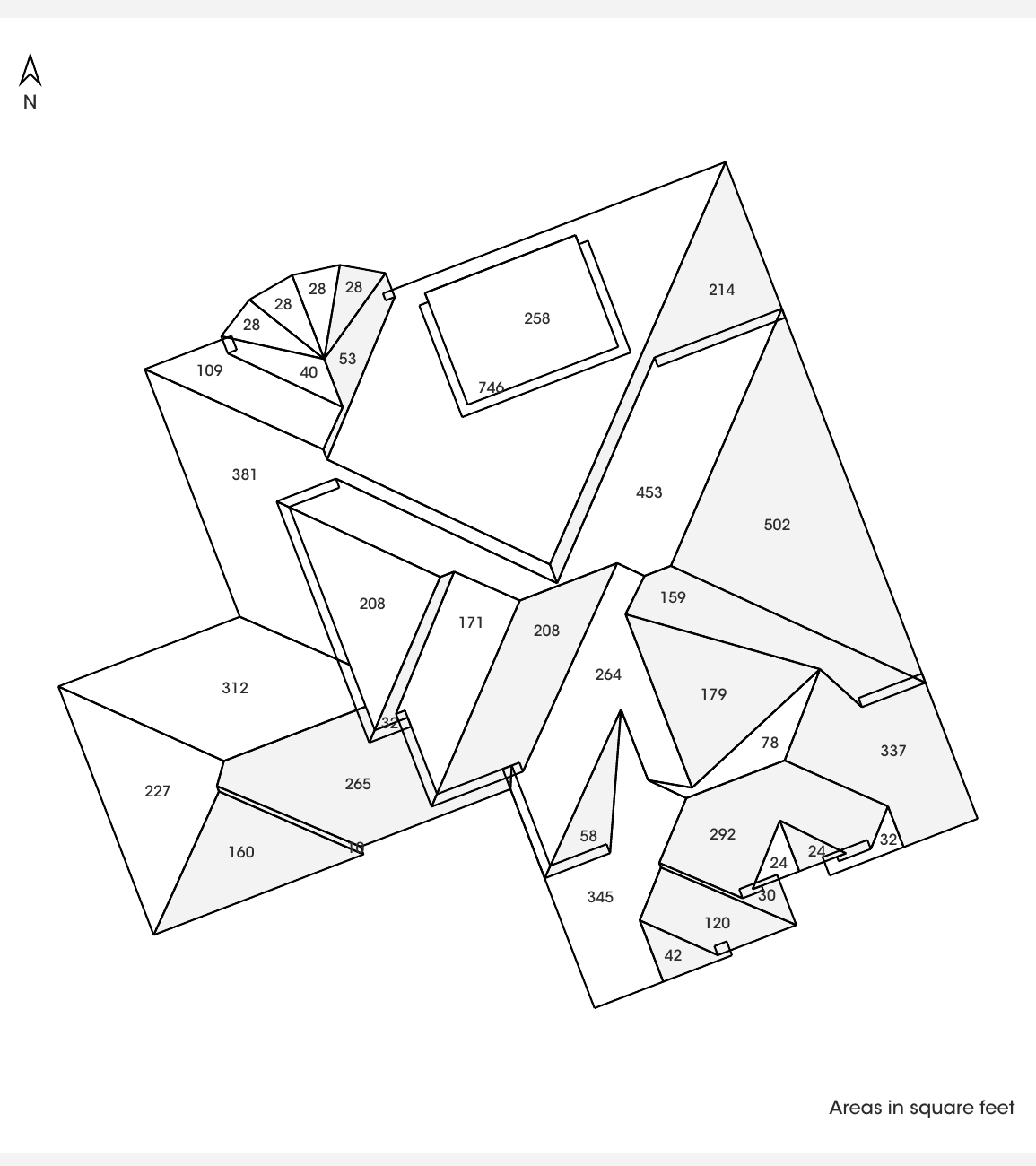
What it means: A facet is one individual flat surface of a roof. Every distinct sloped section separated by a ridge, hip, valley, wall, or edge can be counted as a separate facet. In traditional roofing language, this is often called a roof plane.
Where you will see it: Measurement reports, aerial roof reports, estimating documents, insurance scopes, and some contractor explanations. Software platforms often use the word “facet.” Manufacturers and trade references more commonly use “roof plane.”
Why it matters: Facet count helps explain roof complexity. A simple gable roof may have only two main planes. A roof with dormers, hips, valleys, additions, and intersecting sections may have many more. More facets usually mean more cuts, more transitions, more flashing, more waste material, and more labor time.
Scope / price / timeline / risk:
- Price: More facets can increase labor and material waste even when total square footage is similar.
- Scope: Transitions between facets may require flashing, valley treatment, ridge cap, hip cap, or other details.
- Timeline: More facets usually require slower, more precise installation.
- Risk: Complex roof geometry creates more water-management points that must be handled correctly.
Understand next: Waste Factor, Hip, Valley, Dormer, Measurement Report
Deep dive: What Is a Facet on a Roof?
Ridge
What it means: The ridge is the highest horizontal line of the roof where two sloping roof planes meet.
Where you will see it: Measurement reports, roof diagrams, estimates, ridge cap line items, and ridge vent line items.
Why it matters: The ridge is where ridge cap shingles are installed. It may also be where a ridge vent is installed for attic ventilation. Both are separate from the field shingles installed on the main roof planes.
Scope / price / timeline / risk:
- Price: Ridge cap and ridge vent are often measured in linear feet.
- Scope: A complete estimate should account for ridge cap. If ridge ventilation is part of the system, that should be clearly stated.
- Risk: Poor ridge-cap installation can expose a vulnerable roof transition. Poor ventilation planning can affect roof-system performance.
Understand next: Ridge Cap Shingles, Ridge Vent, Roof Plane
Valley
What it means: A valley is the internal angle where two sloping roof planes meet and direct water downward.
Where you will see it: Measurement reports, roof diagrams, estimates, inspection notes, and leak-diagnosis conversations.
Why it matters: Valleys handle concentrated water flow. Because more water moves through a valley than across a flat roof plane, valleys require careful waterproofing and installation.
Scope / price / timeline / risk:
- Price: Valley treatment may appear as a separate line item, especially when metal valley flashing or additional membrane is specified.
- Scope: Valleys typically require underlayment protection and a defined installation method.
- Risk: Valleys are common leak-risk areas when flashing, membrane, or shingle placement is incomplete or poorly installed.
Understand next: Flashing, Ice and Water Shield, Open Valley, Closed Valley
Hip
What it means: A hip is the external sloping edge where two roof planes meet and project outward. It is the outside counterpart to a valley.
Where you will see it: Measurement reports, roof diagrams, estimates, and hip cap line items.
Why it matters: Hips add complexity because shingles must be cut along angled intersections, and hip cap shingles are required to cover the edge. A roof with many hips usually has more cuts and more waste than a simple gable roof.
Scope / price / timeline / risk:
- Price: Hip cap material is separate from field shingles.
- Scope: Each hip must be capped correctly.
- Timeline: Multiple hips add labor time.
- Risk: Poorly capped hips can expose vulnerable roof intersections.
Understand next: Ridge Cap Shingles, Waste Factor, Hip Roof, Facet
Dormer
What it means: A dormer is a roofed structure that projects from a sloped roof, often containing a window.
Where you will see it: Measurement reports, roof diagrams, estimates, inspection notes, and visual roof assessments.
Why it matters: Dormers add roof planes, valleys, wall intersections, and flashing requirements. They increase complexity beyond simple roof square footage.
Scope / price / timeline / risk:
- Price: Dormers can increase labor, flashing material, and waste factor.
- Scope: Dormers usually require step flashing, valley treatment, and careful wall-to-roof waterproofing.
- Timeline: Dormers require slower detail work.
- Risk: Dormer flashing failures are a common source of leaks when not handled correctly.
Understand next: Step Flashing, Valley, Facet, Waste Factor
Rake
What it means: The rake is the sloped edge of a gable roof. It runs diagonally from the eave up toward the ridge.
Where you will see it: Measurement reports, roof diagrams, drip edge line items, and edge-metal specifications.
Why it matters: The rake edge needs edge protection. Drip edge and starter strip are commonly installed along rake edges to protect the roof deck and help resist wind uplift.
Scope / price / timeline / risk:
- Price: Rake drip edge is typically measured in linear feet.
- Scope: A complete asphalt-shingle installation should account for edge metal at rake edges.
- Risk: Missing or poorly installed edge protection can expose decking and fascia to water damage.
Understand next: Eave, Drip Edge, Starter Strip
Eave
What it means: The eave is the lower horizontal edge of the roof, often where gutters are attached and where the roof overhang extends beyond the exterior wall.
Where you will see it: Measurement reports, code discussions, estimates, ice-barrier requirements, and gutter-related scope.
Why it matters: The eave is one of the most important water-management areas on a roof. Drip edge, starter strip, and ice-barrier protection often converge here.
Scope / price / timeline / risk:
- Scope: Eaves commonly require drip edge, starter strip, underlayment, and ice-barrier protection where required by code or specification.
- Risk: Improperly protected eaves can contribute to decking rot, fascia damage, and ice-dam leaks in cold climates.
Understand next: Drip Edge, Ice and Water Shield, Starter Strip, Ice Dam
Pitch / Slope
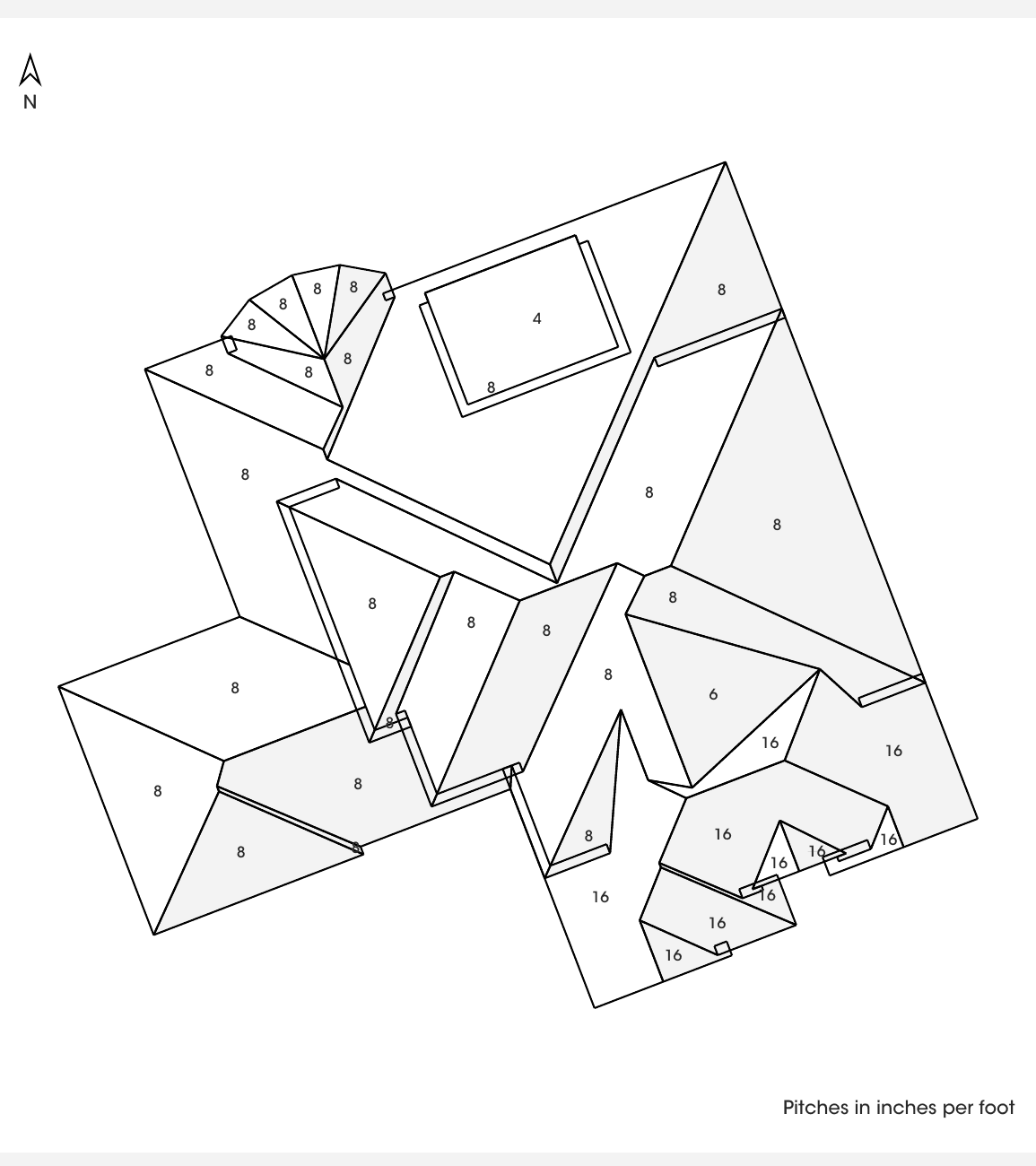
What it means: Pitch describes how steep a roof is. It is usually written as a ratio. A 6/12 pitch means the roof rises 6 inches for every 12 inches of horizontal run.
Where you will see it: Measurement reports, estimates, building-code references, and material specifications.
Why it matters: Pitch affects surface area, labor difficulty, safety requirements, material suitability, and cost. A steeper roof has more actual roof surface than the same footprint at a lower pitch.
Scope / price / timeline / risk:
- Price: Steeper roofs often require more labor and more safety setup. They also have more surface area than a flat footprint suggests.
- Timeline: Steeper roofs usually take longer to install.
- Scope: Very low-slope areas may require different roofing materials or installation methods.
- Risk: Using the wrong material on a low-slope section can create drainage and warranty problems.
Understand next: Square, True Surface Area, Low-Slope Roofing, Measurement Report
Pitch reference table:
| Pitch | Rise per 12" Run | Approx. Area Multiplier | General Walkability | Common Meaning |
|---|---|---|---|---|
| 3/12 | 3 inches | 1.031 | Easier to walk | Low slope; may need special review |
| 4/12 | 4 inches | 1.054 | Easier to walk | Common minimum for standard shingles |
| 6/12 | 6 inches | 1.118 | Moderate | Common residential pitch |
| 8/12 | 8 inches | 1.202 | More difficult | Often increases labor complexity |
| 10/12 | 10 inches | 1.302 | Difficult | Requires more safety planning |
| 12/12 | 12 inches | 1.414 | Very steep | Requires staging or specialized setup |
Section
Part 2: The Roof System Under the Shingles
A roof is not only shingles. It is a system of layers and accessories installed over the roof deck. These hidden components affect water protection, warranty compliance, wind resistance, and long-term performance.
Decking / Sheathing
What it means: Decking, also called sheathing, is the wood surface attached to the roof framing. It is usually plywood or OSB. Underlayment, flashing, and shingles are installed over it.
Where you will see it: Estimates, change orders, inspection notes, and roof replacement scopes.
Why it matters: Decking condition cannot always be fully confirmed until the old roof is removed. If the decking is rotted, delaminated, soft, or damaged, it must be replaced before the new roofing system is installed.
Scope / price / timeline / risk:
- Price: Replacement is usually priced per sheet or per defined repair area. Pricing varies by material, market, access, and labor.
- Timeline: Significant decking replacement can add time to the project.
- Risk: New shingles should not be installed over compromised decking. Fasteners may not hold properly, and the roof surface may remain unstable.
- Scope: A complete estimate should state how decking replacement will be identified, documented, priced, and approved.
Understand next: Change Order, Contingency, Tear-Off, Deck Inspection
Underlayment
What it means: Underlayment is a protective sheet material installed over the roof deck and beneath the shingles. It acts as a secondary water-resistance layer.
Where you will see it: Estimates, material specifications, warranty requirements, and installation scopes.
Why it matters: If water gets past the shingles, underlayment helps protect the decking below. Modern synthetic underlayment is common on quality asphalt-shingle installations, while older or lower-cost specifications may still reference felt paper.
Scope / price / timeline / risk:
- Price: Synthetic underlayment usually costs more than felt but provides stronger tear resistance and better handling.
- Scope: Full roof-deck coverage should be clearly included.
- Risk: Missing or poorly installed underlayment reduces the system’s secondary protection.
Understand next: Synthetic Underlayment, Felt Paper, Ice and Water Shield
Ice and Water Shield
What it means: Ice and water shield is a self-adhering waterproof membrane installed at vulnerable areas of the roof, especially eaves, valleys, and penetrations.
Where you will see it: Estimates, code-related discussions, insurance scopes, and material specifications.
Why it matters: Ice and water shield is different from general underlayment. It is designed to adhere to the deck and seal around fasteners. In many cold-climate jurisdictions, an ice barrier is required at eaves under asphalt shingles. Local code adoption and installation details should be verified for the specific property.
Scope / price / timeline / risk:
- Price: It costs more than standard underlayment and is usually used only where needed or required.
- Scope: A clear estimate should state where ice and water shield will be installed.
- Risk: In areas vulnerable to ice dams or concentrated water flow, missing membrane protection can increase leak risk.
Understand next: Eave, Valley, Ice Dam, Code Compliance, Underlayment
Starter Strip
What it means: Starter strip is a specialized shingle strip installed at the eave and rake edges before the first visible course of shingles.
Where you will see it: Estimates, installation specifications, and manufacturer instructions.
Why it matters: Starter strip helps seal the first row of shingles and supports wind resistance at roof edges. It is a separate product from the main field shingles.
Scope / price / timeline / risk:
- Price: Usually a smaller line item, measured by length.
- Scope: Should be included along eaves and rake edges where required by the shingle system.
- Risk: Missing starter strip can weaken wind resistance and may affect warranty compliance.
Understand next: Eave, Rake, Drip Edge, Manufacturer Warranty
Ridge Cap Shingles
What it means: Ridge cap shingles are installed along ridges and hips to cover the gap where two roof planes meet.
Where you will see it: Estimates, product specifications, and ridge or hip measurements.
Why it matters: Standard field shingles are not designed to finish ridges and hips by themselves. Ridge cap shingles provide a finished, protective cover at those roof intersections.
Scope / price / timeline / risk:
- Price: Ridge cap is usually measured by linear foot or by bundle quantity.
- Scope: Every ridge and hip should be accounted for.
- Risk: Poorly installed cap shingles can expose high points of the roof to water or wind damage.
Understand next: Ridge, Hip, Ridge Vent
Architectural Shingles / Dimensional Shingles / Laminate Shingles
What it means: Architectural, dimensional, and laminate shingles are common names for multi-layer asphalt shingles with a dimensional appearance.
Where you will see it: Estimates, product selections, manufacturer brochures, and warranty documents.
Why it matters: Architectural shingles are the common modern standard for residential asphalt-shingle replacement. They are generally heavier and more wind-resistant than older 3-tab shingles, but the specific product line still matters.
Scope / price / timeline / risk:
- Price: Product tier affects cost. Standard architectural shingles and premium designer or impact-resistant shingles are not the same price category.
- Scope: A complete estimate should name the manufacturer and product line, not only the generic category.
- Risk: Vague material descriptions make estimates harder to compare.
Understand next: 3-Tab Shingles, Manufacturer Warranty, Impact Resistance, Square
Section
Part 3: Water Control and Flashing
Water control is the purpose of the roof system. Shingles shed water across broad surfaces. Flashing and edge details protect the places where water is most likely to enter: walls, chimneys, valleys, vents, edges, and penetrations.
Flashing
What it means: Flashing is metal or specialty material installed at roof edges, walls, valleys, chimneys, vents, and other interruptions to prevent water entry.
Where you will see it: Estimates, inspection reports, leak-diagnosis notes, and installation scopes.
Why it matters: Many roof leaks occur at transitions, not in the middle of the shingle field. Flashing is the system that protects those transitions.
Scope / price / timeline / risk:
- Price: Flashing cost depends on the number and type of transitions on the roof.
- Scope: A complete estimate should make flashing responsibilities clear, especially at chimneys, dormers, sidewalls, valleys, and penetrations.
- Risk: Reusing old or damaged flashing can compromise a new roof system.
Understand next: Step Flashing, Counter Flashing, Drip Edge, Pipe Boot, Valley Flashing
Step Flashing
What it means: Step flashing consists of small L-shaped metal pieces installed in overlapping steps where a roof plane meets a vertical wall.
Where you will see it: Estimates, dormer details, chimney sidewall details, and leak diagnoses.
Why it matters: Step flashing channels water away from the wall-roof intersection one shingle course at a time. It is especially important around dormers, chimneys, and sidewalls.
Scope / price / timeline / risk:
- Price: Usually measured by linear foot or included within a wall/chimney flashing scope.
- Scope: Wall intersections should identify whether step flashing is being replaced or reused.
- Risk: Missing, corroded, or improperly layered step flashing is a common cause of leaks.
Understand next: Counter Flashing, Kick-Out Flashing, Dormer
Counter Flashing
What it means: Counter flashing is metal installed over the top edge of another flashing system, often at masonry walls or chimneys. It helps prevent water from running behind the flashing below.
Where you will see it: Chimney flashing scopes, masonry wall details, and leak-diagnosis reports.
Why it matters: Around masonry, step flashing and counter flashing work together. Step flashing protects the shingle-to-wall transition. Counter flashing protects the upper edge of that system.
Scope / price / timeline / risk:
- Price: Often included in a chimney flashing scope.
- Scope: A chimney or masonry wall detail should account for both the roof-side and wall-side flashing.
- Risk: Sealant alone is not a durable substitute for a properly designed flashing system.
Understand next: Step Flashing, Chimney Flashing, Cricket
Drip Edge
What it means: Drip edge is metal installed along roof edges to direct water away from the decking, fascia, and roof edge.
Where you will see it: Estimates, code discussions, edge-metal specifications, and inspection reports.
Why it matters: Drip edge protects vulnerable roof edges. It helps water shed into the gutter or away from the fascia instead of curling back under the shingles.
Scope / price / timeline / risk:
- Price: Usually measured by linear foot.
- Scope: A complete asphalt-shingle estimate should account for drip edge at eaves and rakes.
- Risk: Missing or poorly installed drip edge can contribute to fascia damage and edge-deck rot.
Understand next: Eave, Rake, Fascia, Code Compliance
Pipe Boot / Plumbing Vent Boot
What it means: A pipe boot is a flashing component that seals around a plumbing vent pipe where it passes through the roof.
Where you will see it: Estimates, replacement scopes, inspection notes, and leak-diagnosis reports.
Why it matters: Plumbing vent penetrations are common roof leak points. The boot seal can age faster than the roof covering itself, so pipe boots are commonly replaced during a roof replacement.
Scope / price / timeline / risk:
- Price: Cost depends on the number and type of penetrations.
- Scope: A complete replacement scope should state whether existing pipe boots will be replaced.
- Risk: Leaving aged pipe boots in place can create an avoidable leak point on an otherwise new roof.
Understand next: Flashing, Roof Penetration, Scope of Work
Cricket / Saddle
What it means: A cricket, also called a saddle, is a small peaked structure built on the uphill side of a chimney or wide penetration to divert water around it.
Where you will see it: Estimates, chimney flashing scopes, code discussions, and inspection reports.
Why it matters: A wide chimney can trap water on the uphill side. A cricket redirects that water so it does not pool behind the chimney.
Scope / price / timeline / risk:
- Price: Cost depends on chimney size, roof pitch, material, and whether framing is required.
- Scope: Larger chimneys may require a cricket under applicable code or installation standards.
- Risk: Missing crickets behind wide chimneys can contribute to water ponding, rot, and leaks.
Understand next: Chimney Flashing, Counter Flashing, Code Compliance
Section
Part 4: Ventilation
Roof ventilation manages heat and moisture in the attic. It affects shingle life, condensation risk, ice-dam potential, and warranty requirements. Ventilation is not a decorative accessory; it is part of the roof system.
Ridge Vent
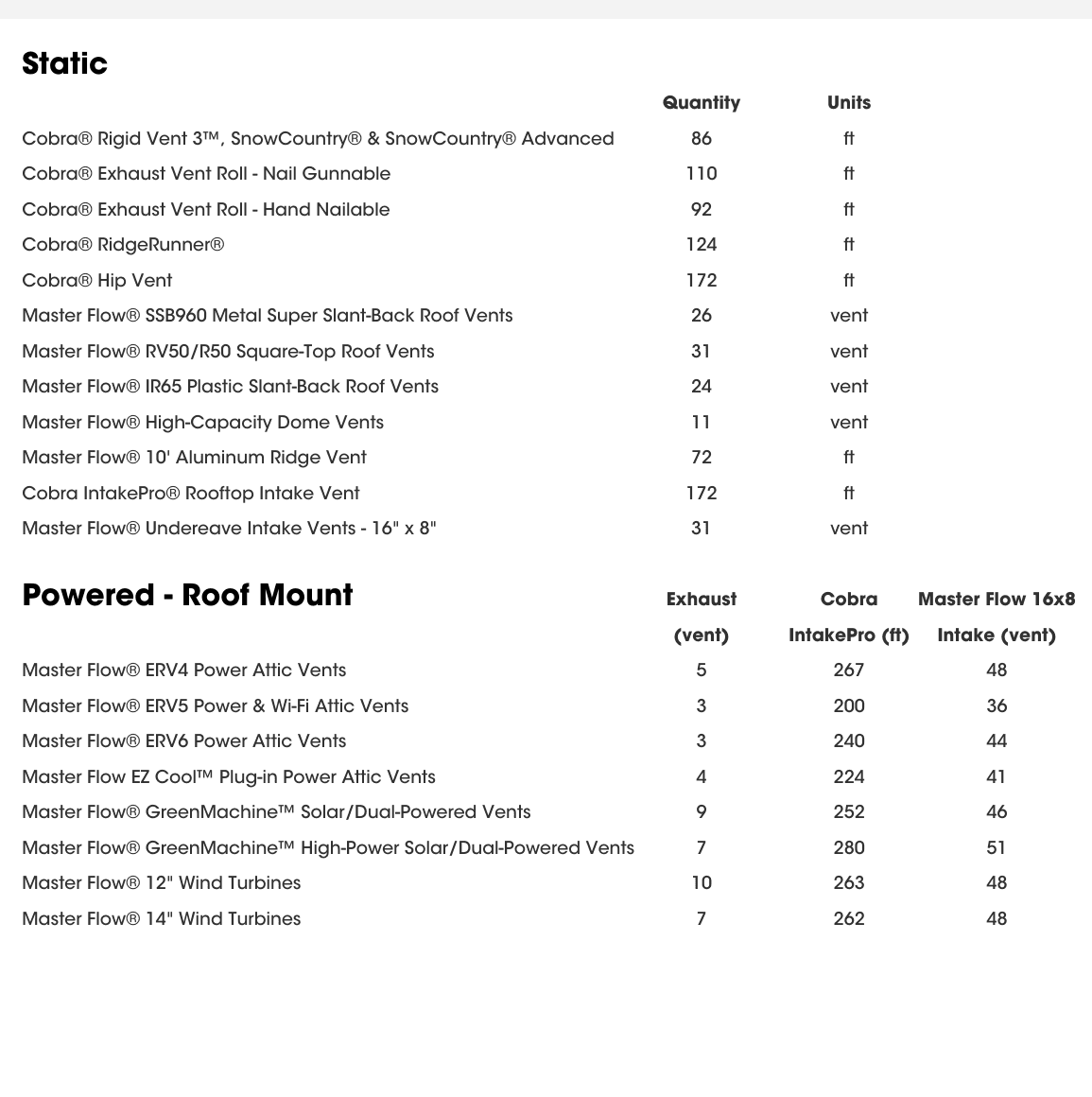
What it means: A ridge vent is an exhaust vent installed along the roof ridge, usually covered by ridge cap shingles.
Where you will see it: Estimates, ventilation assessments, warranty discussions, and roof replacement scopes.
Why it matters: Ridge vents allow warm, moist attic air to escape from the highest point of the roof. They must work with intake ventilation, usually at the soffits.
Scope / price / timeline / risk:
- Price: Usually measured by linear foot.
- Scope: A ridge vent should be specified as part of a balanced ventilation plan.
- Risk: Exhaust ventilation without adequate intake may not function properly.
Understand next: Soffit Vent, Ventilation Balance, Manufacturer Warranty
Soffit Vent
What it means: A soffit vent is an intake vent located in the underside of the roof overhang.
Where you will see it: Ventilation assessments, inspection reports, and some replacement scopes.
Why it matters: Soffit vents allow cooler outside air to enter the attic. This intake air supports exhaust through ridge vents or other exhaust vents.
Scope / price / timeline / risk:
- Scope: Intake should be verified before exhaust ventilation is added or changed.
- Risk: Without adequate intake, the ventilation system may be incomplete.
Understand next: Ridge Vent, Ventilation Balance, Net Free Area
Ventilation Balance
What it means: Ventilation balance means the attic has adequate intake and exhaust ventilation working together.
Where you will see it: Manufacturer warranty requirements, ventilation assessments, building-code discussions, and inspection reports.
Why it matters: Ventilation is a system. Adding an exhaust vent alone does not solve airflow if intake is blocked or insufficient.
Scope / price / timeline / risk:
- Scope: A complete roof replacement should consider existing attic ventilation conditions.
- Risk: Poor ventilation can contribute to condensation, heat buildup, shingle aging, ice dams, and warranty issues.
Understand next: Ridge Vent, Soffit Vent, Net Free Area, Manufacturer Warranty
Section
Part 5: Measurement and Estimating Language
These terms turn the roof into quantities. They explain how roof size, complexity, material, and labor become line items on an estimate.
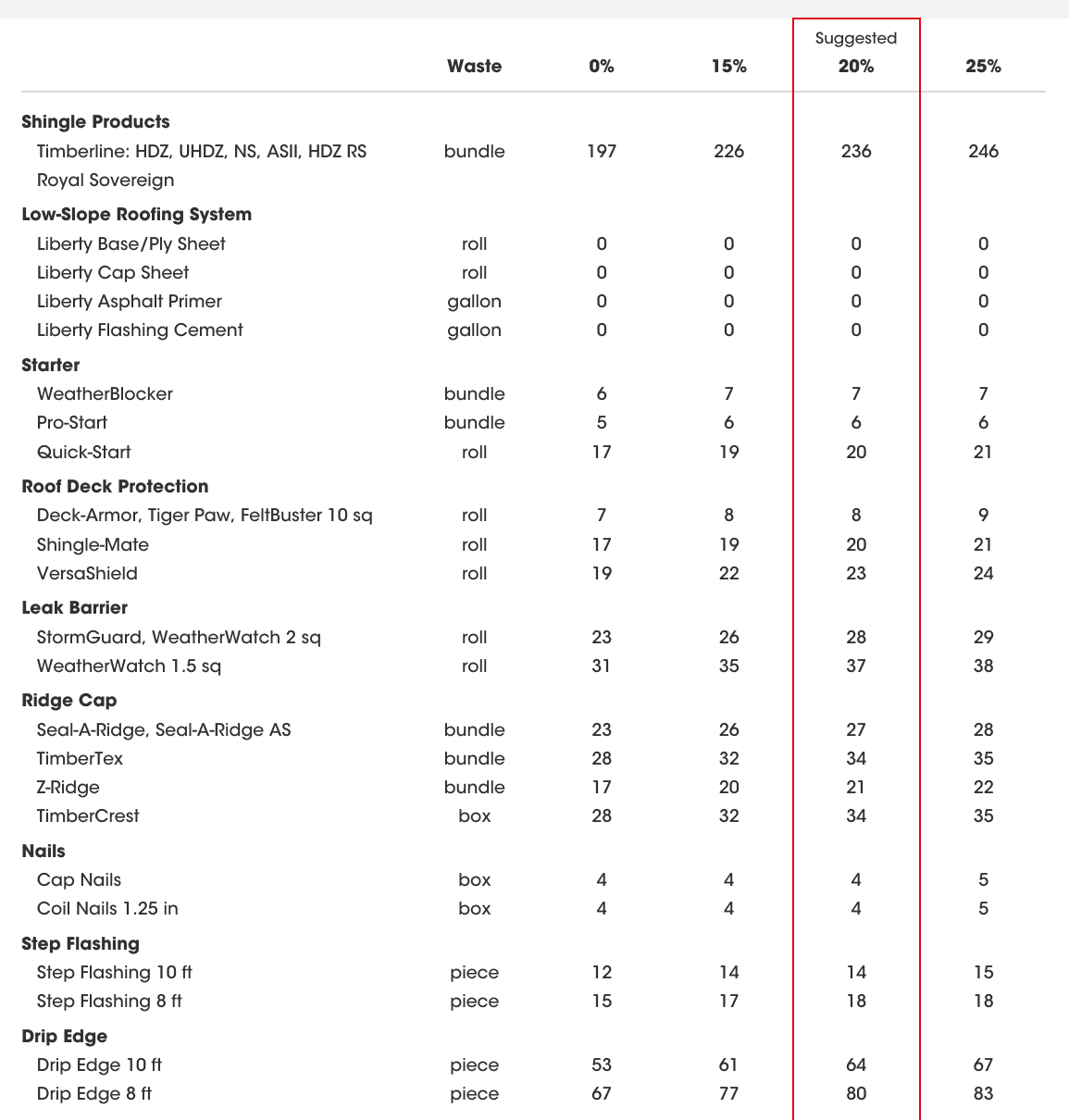
Square
What it means: A square is a roofing measurement equal to 100 square feet of roof surface.
Where you will see it: Estimates, material orders, pricing comparisons, and roof measurement reports.
Why it matters: Roofing materials are commonly ordered and priced in squares. If an estimate lists 22 squares, it means approximately 2,200 square feet of roof surface before any separate waste or accessory calculations.
Scope / price / timeline / risk:
- Price: Many roofing costs are calculated per square.
- Scope: Square count helps compare estimates only when the same scope and material assumptions are being used.
- Risk: Comparing only price per square can be misleading if one estimate excludes important components.
Understand next: Bundle, Waste Factor, True Surface Area
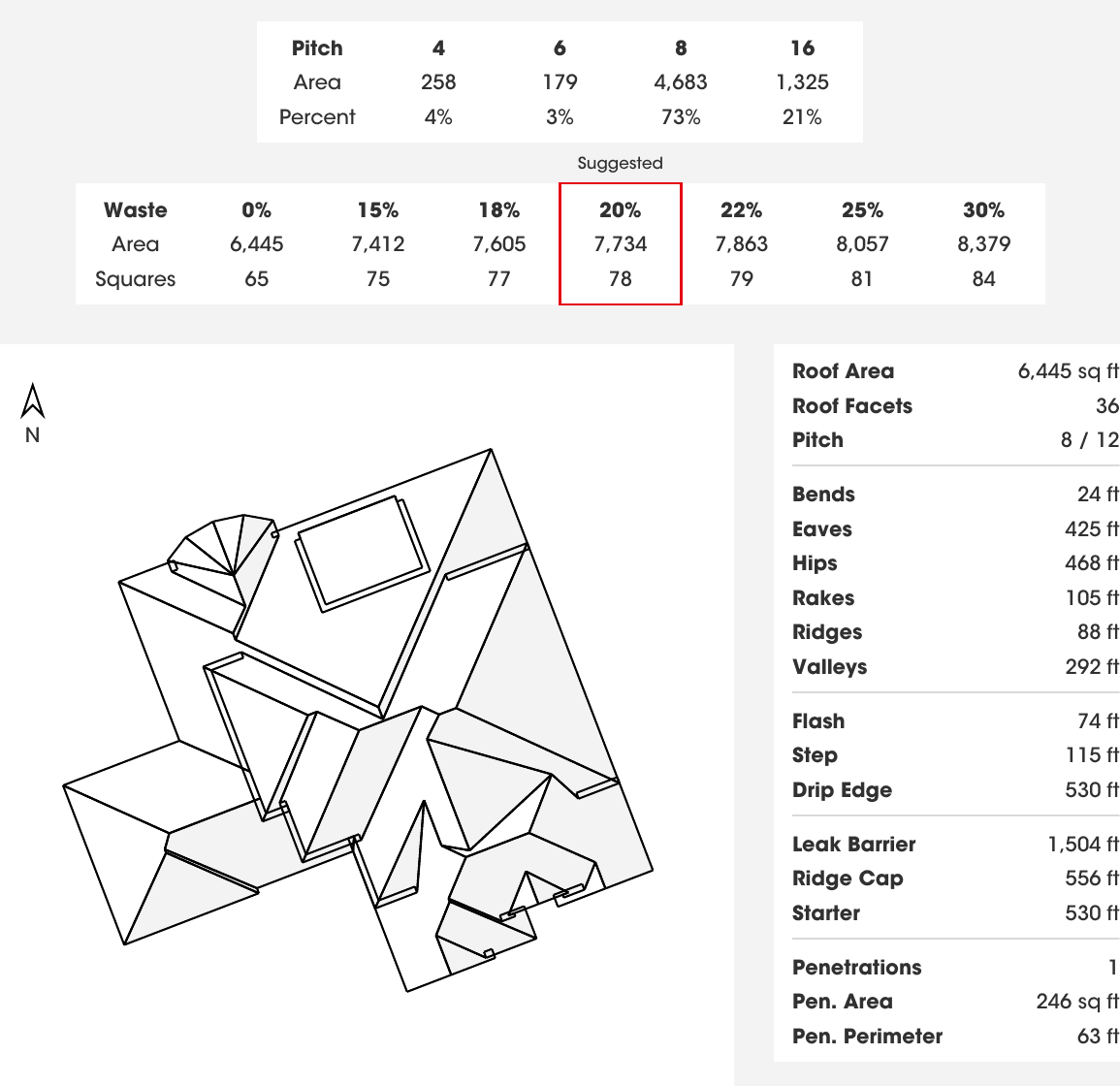
Waste Factor
What it means: Waste factor is the percentage of extra material included to account for cuts, overlaps, angles, hips, valleys, starter courses, and unusable pieces.
Where you will see it: Estimates, material calculations, measurement reports, and contractor explanations.
Why it matters: Waste factor is not automatically a sign of wasteful work. It is usually a geometry requirement. Complex roofs need more cut material than simple roofs.
Scope / price / timeline / risk:
- Price: Higher waste factor increases material quantity.
- Scope: Simple roofs usually need less waste allowance than complex roofs with hips, valleys, dormers, and many facets.
- Risk: Too little material can interrupt the project. Too much material can inflate cost unnecessarily.
Understand next: Facet, Square, Hip, Valley
Measurement Report
What it means: A measurement report is a document that provides roof dimensions, often using aerial, satellite, or software-assisted measurement.
Where you will see it: Contractor estimate preparation, roof reports, insurance scopes, and measurement-platform documents.
Why it matters: A measurement report helps define roof area, roof planes or facets, pitch, ridge lengths, valley lengths, eave lengths, and other quantities that influence the estimate.
Scope / price / timeline / risk:
- Scope: A measurement report provides a documented basis for quantities.
- Price: Accurate measurements reduce the risk of material shortages or major quantity errors.
- Risk: An estimate without clear measurements may be harder to verify.
Understand next: Facet, Square, Pitch, Waste Factor, Linear Foot
True Surface Area vs. Footprint
What it means: The roof footprint is the area seen from directly above. The true roof surface area is the actual sloped area that must be covered. Because pitch adds surface, true roof area is larger than the flat footprint.
Where you will see it: Measurement reports, estimate calculations, and roof-size explanations.
Why it matters: A home’s floor area is not the same as its roof area. Roof pitch, overhangs, dormers, garages, porches, and additions all affect the roof surface that must be replaced.
Scope / price / timeline / risk:
- Price: True surface area determines material quantity.
- Scope: Pitch-adjusted area is the correct basis for roof material calculations.
- Risk: Using footprint alone can understate the actual work.
Understand next: Pitch, Square, Measurement Report
Linear Foot
What it means: A linear foot measures length. It is used for components measured by distance rather than surface area.
Where you will see it: Estimates for ridge cap, drip edge, valley metal, flashing, gutters, and certain ventilation components.
Why it matters: Not every roof component is priced by square. Ridges, edges, valleys, and flashing are often measured by length.
Scope / price / timeline / risk:
- Price: Linear-foot items can add materially to complex roofs with many edges and transitions.
- Scope: Linear measurements should correspond to the roof measurement report or documented takeoff.
- Risk: Missing linear-foot components can indicate incomplete scope.
Understand next: Ridge, Valley, Drip Edge, Flashing
Section
Part 6: Estimate, Quote, and Scope Language
This is the language of project accountability. These terms define what is included, what is excluded, what happens when hidden conditions are discovered, and how the final project is documented.
Scope of Work
What it means: The scope of work is the written description of what will be done, which materials will be used, which components are included, and what is excluded.
Where you will see it: Estimates, proposals, contracts, and project documentation.
Why it matters: The scope is the center of the estimate. Two estimates can have very different prices because they include different work.
Scope / price / timeline / risk:
- Price: Scope differences explain many quote differences.
- Scope: A complete scope should identify tear-off or overlay, material brand and product, underlayment, ice-barrier details, flashing, vents, drip edge, starter strip, ridge cap, decking protocol, cleanup, permits, and warranty terms.
- Risk: Vague scope creates ambiguity. Ambiguity creates disputes.
Understand next: Line Item, Change Order, Contingency, Exclusions
Change Order
What it means: A change order is a written amendment to the original agreement that documents added work, added cost, changed materials, or changed timeline after the project begins.
Where you will see it: Mid-project communication, contract amendments, invoices, and decking-replacement documentation.
Why it matters: Some conditions cannot be confirmed until tear-off exposes the roof deck. A change order is the proper way to document those conditions before additional work proceeds.
Scope / price / timeline / risk:
- Price: Often used for decking replacement or hidden damage discovered after tear-off.
- Timeline: Added work may extend the schedule.
- Scope: A complete estimate should define how change orders are documented and approved.
- Risk: Verbal-only cost changes create uncertainty. Written documentation protects both parties.
Understand next: Decking, Contingency, Scope of Work, Tear-Off
Contingency
What it means: A contingency is a defined allowance, protocol, or pricing structure for conditions that may be discovered during the work.
Where you will see it: Estimates, contracts, decking-replacement notes, and project terms.
Why it matters: Contingency language shows how uncertainty will be handled before the project starts. It does not mean something will go wrong. It means the process is defined if something is found.
Scope / price / timeline / risk:
- Price: May include per-sheet decking pricing or a defined repair allowance.
- Scope: Should state what conditions trigger additional work and how approval happens.
- Risk: No contingency language means the process is undefined when hidden damage appears.
Understand next: Change Order, Decking, Scope of Work
Tear-Off
What it means: Tear-off is the removal of existing roofing materials down to the roof deck.
Where you will see it: Estimates, replacement scopes, project timelines, and disposal line items.
Why it matters: Tear-off allows the contractor to inspect the deck, replace compromised material, and install the new system over a clean substrate.
Scope / price / timeline / risk:
- Price: Tear-off adds labor and disposal cost.
- Timeline: Tear-off usually takes longer than installing over an existing layer.
- Scope: Should include removal, disposal, deck inspection, and site protection.
- Risk: Without tear-off, hidden damage may remain covered.
Understand next: Overlay, Deck Inspection, Disposal, Change Order
Overlay / Re-Roof
What it means: Overlay, sometimes called re-roofing, means installing new shingles over an existing shingle layer instead of removing the old roof first.
Where you will see it: Lower-cost estimates, repair discussions, and scope comparisons.
Why it matters: Overlay can reduce upfront cost, but it limits deck inspection, adds weight, can reduce installation quality, and may affect warranty options. Local code and manufacturer requirements also matter.
Scope / price / timeline / risk:
- Price: Usually less expensive upfront than tear-off.
- Timeline: Usually faster.
- Scope: Only possible under specific conditions, including existing layer count and roof condition.
- Risk: Hidden damage remains hidden. Future replacement may become more complex.
Understand next: Tear-Off, Decking, Code Compliance, Manufacturer Warranty
Overhead and Profit (O&P)
What it means: Overhead and profit refers to business operating costs and profit margin included in a project price. In insurance restoration, it may be listed separately. In private work, it is often built into line-item pricing.
Where you will see it: Insurance scopes, detailed estimates, restoration documents, and claim-related conversations.
Why it matters: A roofing project price is not only materials and field labor. It also reflects insurance, vehicles, supervision, administration, licensing, safety, warranty support, and business continuity.
Scope / price / timeline / risk:
- Price: May appear separately in insurance scopes or be embedded in pricing.
- Scope: Important when comparing insurance documents with private estimates.
- Risk: Misreading O&P can make two estimates appear less comparable than they are.
Understand next: Insurance Scope, Supplement, Xactimate
Section
Part 7: Warranty Language
Warranty language defines who is responsible if something fails, what is covered, what is excluded, how long coverage lasts, and what conditions must be met.
Manufacturer Warranty
What it means: A manufacturer warranty covers defects in the roofing materials themselves.
Where you will see it: Manufacturer documents, contractor proposals, warranty registrations, and sales materials.
Why it matters: Manufacturer warranties usually cover material defects. They do not automatically cover installation errors unless the project qualifies for an enhanced or system warranty that includes labor coverage.
Scope / price / timeline / risk:
- Price: Standard manufacturer coverage is typically included with eligible materials. Enhanced warranty options may require specific products, certified installation, and registration.
- Scope: Coverage varies by manufacturer, product line, warranty tier, and installation conditions.
- Risk: Improper ventilation, incorrect installation, unauthorized modifications, or failure to follow manufacturer requirements can affect coverage.
Understand next: Workmanship Warranty, Certified Installer, System Warranty
Workmanship Warranty
What it means: A workmanship warranty is provided by the contractor and covers installation-related errors.
Where you will see it: Contracts, proposals, warranty documents, and post-installation paperwork.
Why it matters: If a roof problem is caused by installation rather than a material defect, workmanship coverage is the relevant warranty.
Scope / price / timeline / risk:
- Price: Usually included in the project agreement.
- Scope: Duration and coverage vary significantly by contractor.
- Risk: Workmanship coverage depends on the contractor’s ability and willingness to honor the warranty over time.
Understand next: Manufacturer Warranty, Certified Installer, Warranty Exclusions
Certified Installer
What it means: A certified installer is a contractor recognized by a manufacturer after meeting that manufacturer’s requirements.
Where you will see it: Contractor credentials, manufacturer websites, warranty discussions, and proposal materials.
Why it matters: Certification can determine whether enhanced manufacturer warranties are available. Requirements differ by manufacturer and certification level.
Scope / price / timeline / risk:
- Scope: Certification may allow access to extended or enhanced warranty options.
- Risk: Not all certifications are equal. The warranty document should state exactly what coverage applies.
Understand next: Manufacturer Warranty, System Warranty, Workmanship Warranty
Section
Part 8: Insurance and Restoration Terms
Insurance terms matter when a roof replacement is connected to storm damage, a claim, or an insurance scope. Coverage varies by policy, carrier, state, and documented damage. The policy controls the final coverage decision.
Actual Cash Value (ACV)
What it means: Actual Cash Value is the replacement cost of the roof minus depreciation for age and condition.
Where you will see it: Insurance claim documents, adjuster estimates, policy summaries, and settlement letters.
Why it matters: ACV affects the first payment and sometimes the total amount paid, depending on the policy.
Scope / price / timeline / risk:
- Price: The ACV amount may be lower than the full replacement cost because depreciation has been deducted.
- Risk: If the policy is ACV-only, the homeowner may be responsible for more of the replacement cost.
Understand next: Replacement Cost Value, Recoverable Depreciation, Deductible
Replacement Cost Value (RCV)
What it means: Replacement Cost Value is the estimated cost to replace the roof with comparable materials at current pricing, before depreciation is applied.
Where you will see it: Insurance policies, claim documents, and adjuster estimates.
Why it matters: On many RCV policies, the insurer may first pay ACV and then release recoverable depreciation after the work is completed and documented.
Scope / price / timeline / risk:
- Price: RCV usually represents the full approved replacement value, less deductible and subject to policy terms.
- Timeline: Payment may arrive in stages.
- Risk: Assuming the first check is the full payment can create confusion.
Understand next: ACV, Recoverable Depreciation, Supplement
Supplement
What it means: A supplement is a request for additional insurance funds to cover items missing from the original claim scope or discovered later.
Where you will see it: Contractor-insurer communication, insurance claim documents, and restoration scopes.
Why it matters: Supplements are common in insurance restoration because initial scopes may miss code-required items, hidden conditions, quantity errors, or necessary components.
Scope / price / timeline / risk:
- Price: May increase the approved claim amount if properly documented and accepted by the insurer.
- Timeline: Insurance review can add time.
- Risk: Supplements should be documented clearly. They should not be used as vague promises or unexplained cost changes.
Understand next: Scope of Loss, O&P, Xactimate, Code Upgrade
Section
Part 9: Installation Process Terms
These terms describe what happens before and during installation. They help set expectations for project sequence, protection, documentation, and completion.
Deck Inspection
What it means: Deck inspection is the review of the exposed roof deck after tear-off.
Where you will see it: Project updates, tear-off documentation, change orders, and contractor communication.
Why it matters: Deck inspection identifies soft, rotted, delaminated, or damaged decking before the new system is installed.
Scope / price / timeline / risk:
- Scope: Should be part of a tear-off project.
- Timeline: Usually occurs immediately after the old roof is removed.
- Risk: Skipping or rushing deck inspection can allow damaged decking to remain under a new roof.
Understand next: Decking, Tear-Off, Change Order
Dry-In
What it means: Dry-in is the point when the roof deck has been covered with underlayment or other temporary protection so the home is protected from weather before the final roof covering is complete.
Where you will see it: Project timelines, multi-day installation updates, and weather-related planning.
Why it matters: Dry-in is an important project milestone. It reduces exposure risk if installation spans more than one day or weather changes.
Scope / price / timeline / risk:
- Timeline: A roof should not be left exposed without proper protection.
- Risk: Exposed decking during rain can create avoidable damage.
Understand next: Underlayment, Tear-Off, Weather Protection
Code Compliance
What it means: Code compliance means the roof replacement meets the building code adopted by the local jurisdiction.
Where you will see it: Permit documents, inspections, estimates, insurance supplements, and project specifications.
Why it matters: A replacement roof may need to meet current code even when the old roof was installed under older rules. Requirements can include drip edge, ice-barrier placement, ventilation, fastening patterns, permits, and inspections.
Scope / price / timeline / risk:
- Scope: Code-related items should be included where required by the local jurisdiction.
- Price: Code compliance can add necessary materials or labor.
- Risk: Skipping required items can affect inspection, resale, insurance, and warranty outcomes.
Understand next: Permit, Drip Edge, Ice and Water Shield, Ventilation
Frequently Asked Questions
How do I read a roof estimate?
Read the estimate in five passes. First, identify the scope: tear-off or overlay. Second, confirm the materials: manufacturer, product line, underlayment, ice barrier, flashing, starter strip, ridge cap, and vents. Third, review measurements: squares, waste factor, and linear-foot items. Fourth, check the decking protocol. Fifth, compare warranty terms and exclusions.
Why are two roof estimates so different in price?
Most price differences come from scope differences. One estimate may include tear-off, new flashing, ridge ventilation, decking protocol, permits, disposal, and a stronger warranty. Another may exclude or bundle those items. Compare what is included before comparing totals.
What does “per square” mean on a roofing estimate?
“Per square” means per 100 square feet of roof surface. If a roof is 22 squares, that represents about 2,200 square feet of roof surface. Pricing per square helps compare material and labor quantities, but it should not be used alone without reviewing scope and roof complexity.
Should I choose tear-off or overlay?
Tear-off is the more complete approach because it exposes the roof deck, allows damaged decking to be replaced, and gives the new system a clean substrate. Overlay can reduce upfront cost in some cases, but it limits inspection, adds weight, and may affect warranty options. The right choice depends on existing roof condition, layer count, local code, and warranty requirements.
What is a reasonable waste factor?
Waste factor depends on roof complexity. Simple roofs usually require less waste allowance. Roofs with many facets, hips, valleys, dormers, or complex cuts require more. The important question is not whether waste exists. The important question is whether the waste factor matches the roof geometry.
What should I do if a contractor calls about a change order?
Ask for documentation before approving additional work. A clear change order should state what was found, where it was found, why it needs to be corrected, how it is priced, whether it affects the schedule, and whether photos are available. The cost should match the change-order or contingency terms stated in the original agreement whenever possible.
What is the difference between manufacturer warranty and workmanship warranty?
A manufacturer warranty covers defects in the roofing materials. A workmanship warranty covers installation errors by the contractor. They are different protections from different parties. A complete proposal should explain both.
Why does my estimate include items besides shingles?
A roof replacement includes more than shingles. A complete system may include underlayment, ice and water shield, drip edge, starter strip, flashing, ridge cap, ventilation components, pipe boots, fasteners, disposal, permits, cleanup, and warranty documentation. These components protect the roof at different points of risk.
How Kodiak Approaches Roofing Terminology
Every roof replacement estimate should be understandable before work begins.
Kodiak Shield Roofing defines the scope, measurements, materials, warranty terms, and communication process before the project moves forward. The homeowner should not be required to interpret vague line items, guess what is included, or discover important conditions only after installation has started.
That means:
- The measurement basis is documented.
- The scope is defined in writing.
- Materials are named by brand and product line.
- Roofing components are explained by function, not hidden behind jargon.
- Decking replacement protocol is stated before tear-off.
- Warranty terms are separated clearly between manufacturer coverage and workmanship coverage.
- If something changes, it is documented through a defined process.
The goal is not to make homeowners manage the roof replacement. The goal is to make the project clear enough that nothing is left to guesswork.
Request a Structured Roof Estimate
See what is included, how it is measured, and how the scope is documented before work begins.
Request a Structured Roof Estimate